A Sandy nonprofit that has never turned away a patient is halfway to a $10 million endowment goal it says will secure that promise for good.
Neuroworx, the neurological rehabilitation center at 90 W. Albion Village Way, announced its Sustainable Impact Fund has crossed the $5 million mark through pledges and donations. Co-founder Dr. Dale Hull told the Deseret News the center must raise $500,000 to $800,000 every year just to cover operating costs, because roughly one-third of its patients have exhausted their insurance benefits.
Hull said he and co-founder Jan Black created the nonprofit specifically to remove financial barriers, giving patients what they need rather than what insurance will pay for.
"What I always say is that it was the worst business model in the world," Hull said.
From strip mall to 24,000 square feet
Hull suffered a spinal cord injury in a 1999 trampoline accident that left him paralyzed from the upper rib cage down. He recovered enough to carry the Olympic torch at Salt Lake City's 2002 Winter Games. But the experience exposed how quickly insurance runs out: standard coverage for neurological rehab limits patients to 20 to 30 one-hour sessions, according to Black, a licensed physical therapist who said those sessions shrink to about 48 minutes after paperwork.
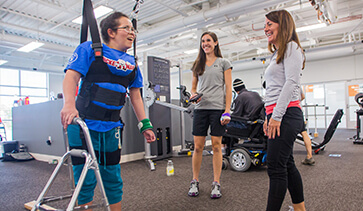
Hull and Black opened Neuroworx in 2004 in a 1,000-square-foot strip mall space. The center now occupies a purpose-built Sandy facility with a therapy pool, unweighting equipment, a height-adjustable car for practicing vehicle transfers, adaptive dance classes and a gym where wheelchair basketball teams practice. A development team serves children ages 8 to 12, and a junior team covers ages 12 to 18. Several players have earned full-ride Division I scholarships.
One Neuroworx patient has competed as a Paralympian in both the Tokyo and Paris Games.
Emily Traveller's road back
Emily Traveller was a 16-year-old American Fork High School sophomore in spring 2022 when a UTV accident at Little Sahara Sand Dunes left her with a C4 spinal cord injury. She spent four months at Craig Hospital in Denver before returning to Utah and beginning therapy at Neuroworx.
Now 21, Traveller has regained some use of her arms and continues visiting the Sandy center regularly. She told the Deseret News the facility became both her workout and her social outlet, a place where physical recovery and mental health reinforced each other. She has built a social media following of more than 800,000 across platforms, sharing her journey and advocating for disability awareness.
The reach is real. Her mother, Kari Traveller, said dozens of visitors recognized Emily and approached her during a family trip to Disney World.
What the endowment means
Hull argues that intensive rehab saves money downstream. A single pressure-sore hospitalization can average $80,000 to $90,000, he said, enough to fund therapy for roughly 10 patients at Neuroworx.
The center accepts most insurance plans, including Medicare and Medicaid, offers a self-pay schedule and has access to the State of Utah Spinal Cord Injury and Brain Injury Rehabilitation Fund, which Hull and Black helped establish through legislation adopted in 2012.
Residents who want to contribute to the Sustainable Impact Fund can find information at neuroworx.org.
.png)